Nail Aesthetics Around the World: Why Every Region Has Its Own Style

Mira

Nail Aesthetics Around the World: Why Every Region Has Its Own Style
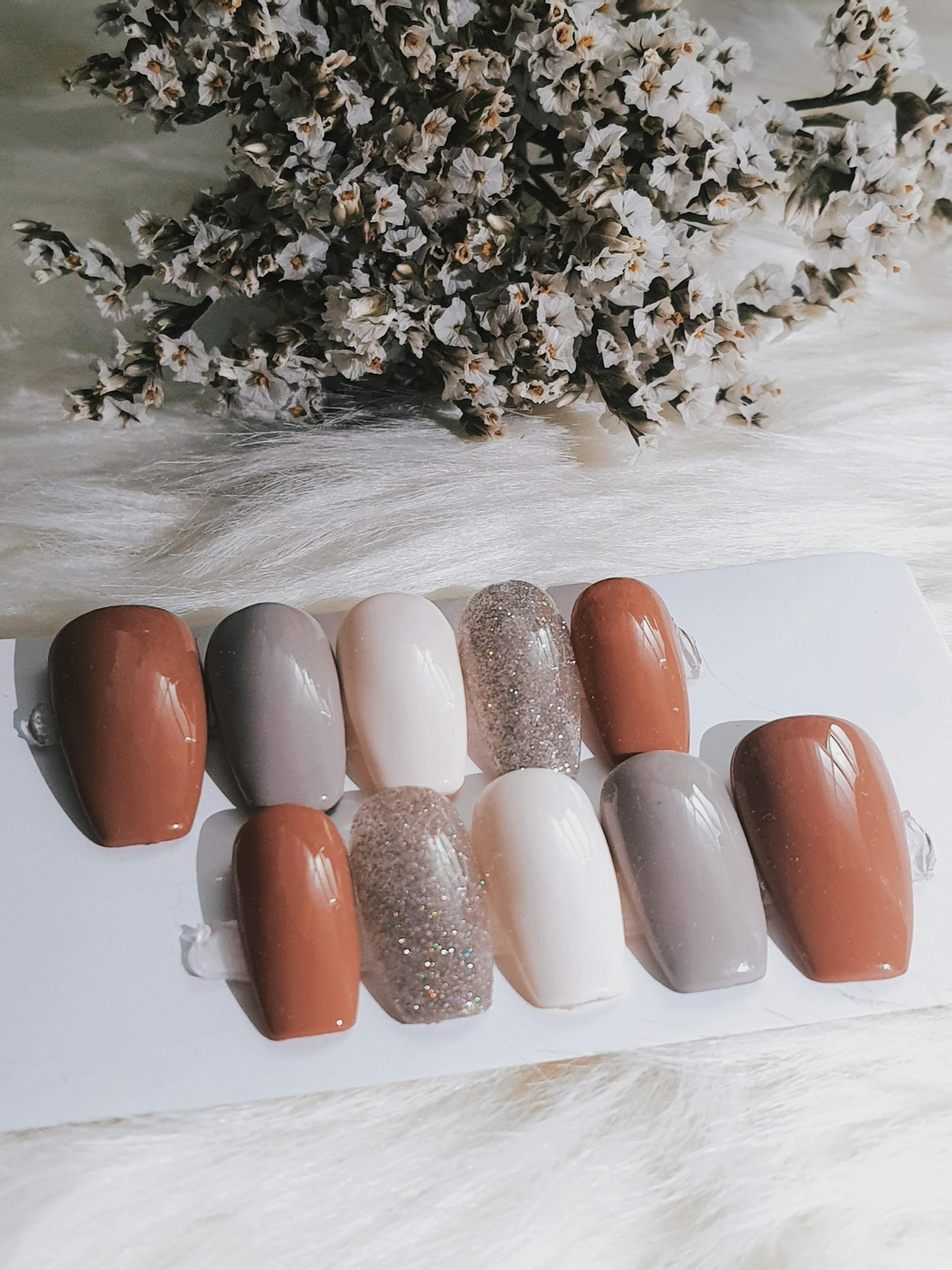
Look at a nail set from Seoul and one from São Paulo, and you're looking at two entirely different visual languages.
One is soft, clean, and barely-there — a sheer pink base, a single pearl, and a mirror-finish chrome that catches light like morning dew. The other is an explosion of color — tropical greens, carnival glitter, bold geometric patterns that announce themselves before you've said a word.
Both are beautiful. Both are intentional. And both are deeply shaped by the cultures, histories, beauty values, and social contexts they come from.
Nail design has become one of the most globally rich and regionally distinct forms of wearable self-expression. In this guide, we're going on a world tour of nail aesthetics — exploring what makes each region's style unique, and more importantly, why those differences exist in the first place.
Why Do Nail Aesthetics Differ Around the World?
Before diving into the regions, it's worth understanding the forces that shape nail culture in any given place. Nail aesthetics are never arbitrary — they're the visible output of deeper cultural, social, and economic factors.
1. Cultural Values & Aesthetic Philosophy Every culture has a dominant philosophy of beauty. Japan's wabi-sabi values simplicity, imperfection, and naturalness. Korean beauty (한국 미용, or K-beauty) prizes clarity, softness, and youthful skin-forward aesthetics. American beauty culture is rooted in freedom, self-expression, and the democratization of glamour. These values don't disappear at the fingertip — they show up in nail design as clearly as in any other art form.
2. Fashion & Pop Culture Industry Where the fashion industry is most powerful, nails become a fashion accessory. France — home to global luxury fashion — developed the most "fashion-adjacent" nail aesthetic on earth: the understated, effortlessly elegant French manicure. Korea — where K-pop and K-drama drive global beauty trends — exports nail aesthetics to the world through music videos, idol content, and beauty influencers.
3. Social & Professional Norms In cultures where professional conservatism is expected (Japan, parts of Northern Europe, corporate Southeast Asia), shorter, more restrained nails are the norm because extreme nail art is socially impractical. In cultures with more expressive fashion norms, longer and more elaborate designs are perfectly acceptable in daily life.
4. Climate & Lifestyle Tropical climates tend toward brighter, bolder color palettes — colors that sing against sun-warmed skin. Northern European and East Asian aesthetics often gravitate toward softer, muted tones that suit cooler-season environments.
5. Economic Positioning In regions where nail salons are aspirational luxury services, designs tend toward maximum impact — the "look how much this costs" aesthetic. In markets where nail services are commoditized and accessible to all, designs can afford to be more experimental and trend-driven.
6. Social Media & Global Cross-Pollination TikTok and Instagram have accelerated the cross-pollination of nail aesthetics globally — Korean trends land in Los Angeles, LA trends surface in Tokyo, and a small nail artist in Vietnam can inspire millions worldwide overnight. But even with this globalization, distinct regional identities persist, shaped by deep cultural roots that social media cannot flatten.
🇰🇷 South Korea — Soft, Clean, and Intentionally Understated
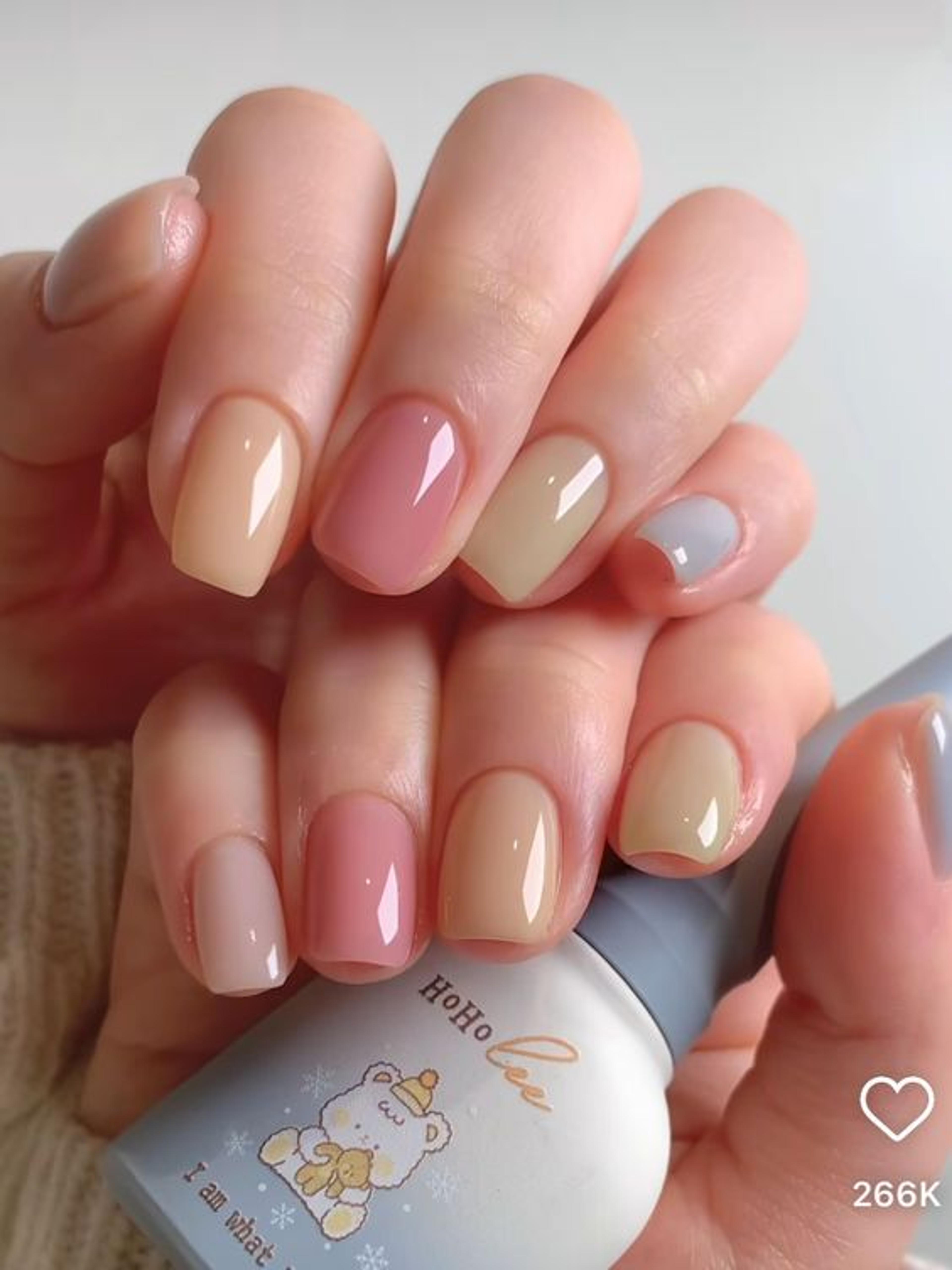
If there is one nail aesthetic that has influenced global nail culture more than any other in the past five years, it is Korean nails.
South Korea's nail identity is rooted in the same philosophy that drives all of K-beauty: clarity, softness, and a dewy, youthful quality. Nails in Korea are typically short to medium length — practical for daily life, but immaculately maintained. The artistry is not in maximalist decoration but in the quality of the base, the precision of the finish, and the carefully chosen single detail that elevates the whole look.
The signature Korean nail aesthetic:
- Glass nails / Jelly nails — ultra-sheer, translucent gels that give the nail a glossy, liquid-glass appearance. No design, just pure luminous texture.
- Milk nails / Cream nails — opaque soft white or ivory, matte or semi-gloss. Clean, fresh, unmistakably Korean.
- Aura nails — soft, blurred gradients that suggest energy or atmosphere rather than defined art
- Minimalist accent details — a single pearl, one small rhinestone at the cuticle, a delicate gold line. Nothing more.
- Short coffin and squoval shapes — practical, wearable, universally flattering
Why Korean nails look like this: K-beauty is fundamentally about skin — glowing, healthy, clear skin is the north star of the entire aesthetic. Nails in Korean beauty culture are an extension of skincare thinking: they should enhance, not compete. Bright, busy, or heavily embellished nails would conflict with the "I woke up like this" freshness that K-beauty projects. Additionally, Korea's professional culture (especially in Seoul's major corporate and service sectors) maintains conservative dress norms — understated nails are practical.
The K-pop exception: When you look at idol-worn nail sets in music videos or red carpets, the story changes dramatically. K-pop performances embrace maximalism — long, embellished, rhinestone-covered sets are entirely acceptable in entertainment contexts. The duality is deliberate: daily nails are soft and restrained; performance nails are theatrical and bold.
Korea's global influence: Korean nail techniques and products have fundamentally changed the industry worldwide. Builder gel, jelly gel textures, glass chrome powders, and the concept of "healthy nail first, art second" are all Korean innovations that are now global standards.
🇯🇵 Japan — Wabi-Sabi, Seasonal Themes & Extreme Craft
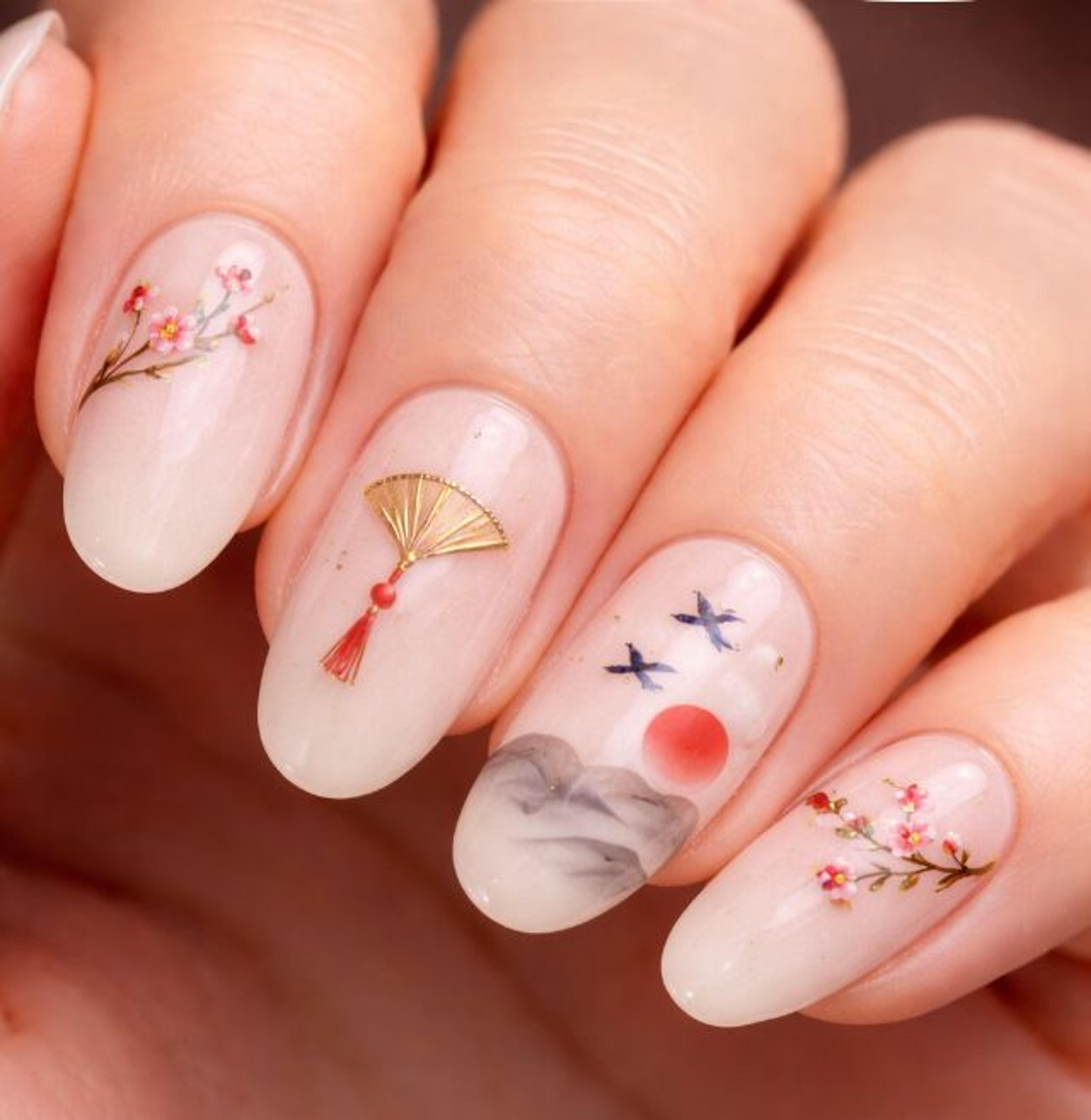
Japan has one of the oldest and most technically sophisticated nail art cultures in the world. Japanese nail artistry is not about trends in the Western sense — it's about craft, seasonal attunement, and the application of the country's broader aesthetic philosophy to a 1.5cm canvas.
The signature Japanese nail aesthetic:
- Seasonal themes — cherry blossom (spring), hydrangea and marine (summer), maple leaf and mushroom (autumn), snowflake and yuzu (winter). Nail designs in Japan follow the calendar with remarkable intentionality.
- Wabi-sabi minimalism — natural forms, organic imperfection, muted palettes of ivory, sage, terracotta, and nude
- Hyperdetailed hand-painting — tiny scenes, botanical illustrations, and character art painted at microscopic scale with extreme precision
- 3D gel sculpting — Japan pioneered modern 3D nail art, particularly intricate gel flowers built petal by petal
- Nuance nails — watercolor-effect washes of translucent color, often in multiple tones overlapping softly
- Gyaru nails (subculture) — long, dramatic, crystal-covered extensions rooted in the flashy Gyaru fashion subculture of the 2000s, still active in specific communities
Why Japanese nails look like this: Japan's broader aesthetic philosophy — rooted in concepts like wabi-sabi (beauty in imperfection), mono no aware (the bittersweet beauty of transience), and ma (the value of negative space) — translates directly into nail design. The emphasis on seasonal themes reflects Japan's deep cultural relationship with nature's rhythms. The extraordinary level of craft reflects a national value placed on shokunin (artisanal mastery) across every discipline, from sushi to calligraphy to nail art.
Japan vs. Korea: Despite both being East Asian K/J-beauty powerhouses, Japanese and Korean nail aesthetics differ meaningfully. Korean nails prioritize skin-forward simplicity and texture-based effects. Japanese nails prioritize craft, seasonal narrative, and detailed painting. Both value quality above all, but express it differently.
🇺🇸 United States — Maximum Expression, Zero Apology
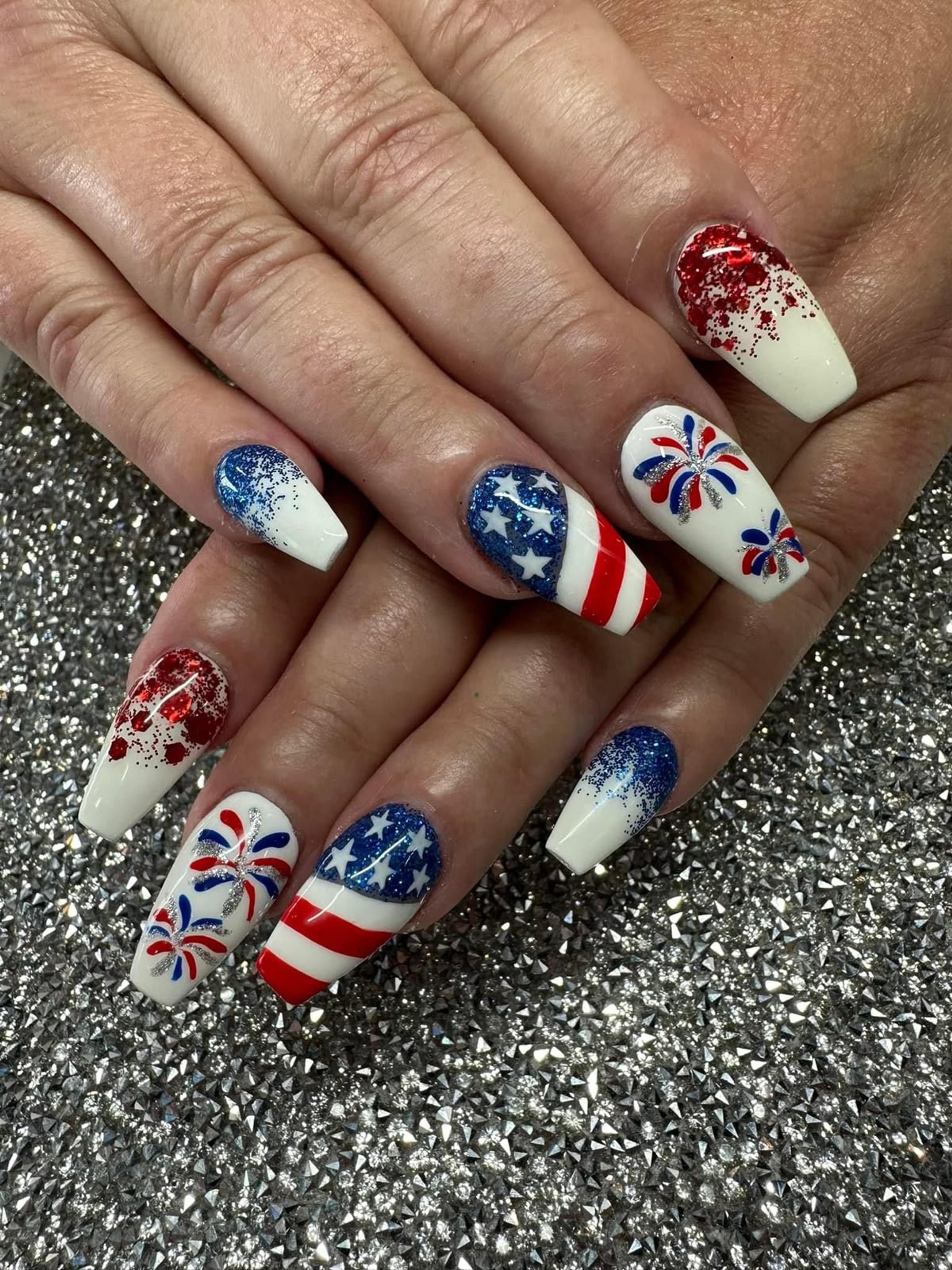
American nail culture is an extension of American cultural identity itself: freedom of expression, individualism, and the belief that more is rarely too much.
The US nail market is the largest in the world — and it is also the most internally diverse. LA nails look different from NYC nails. Black American nail culture has its own rich history. Southern nail culture differs from West Coast. But certain broad tendencies define American nails globally.
The signature American nail aesthetic:
- Long, dramatic lengths — coffin, stiletto, and almond shapes at lengths that would be considered excessive in most other cultures are standard in the US
- Rhinestone flooding and bling — dense crystal coverage, Swarovski-studded sets, and maximum sparkle. "More is more" is a legitimate aesthetic position.
- Ombre and gradient effects — the US has been the dominant market for ombre nails since the technique went mainstream
- Celebrity and pop culture influence — Cardi B, Beyoncé, Kylie Jenner, and other pop culture figures drive nail trends with their personal aesthetics
- Seasonal and holiday nails — Americans dress their nails for every occasion: Halloween sets, Christmas sets, Fourth of July, Valentine's Day — holiday-themed nails are a major commercial category
- Nail as fashion statement — matching nails to outfits, shoes, or accessories is an established styling practice
The Black American nail tradition: It would be incomplete to discuss American nails without acknowledging Black American nail culture, which has independently driven some of the most influential nail aesthetics globally. Long acrylic nails, hand-painted designs, jewel embellishments, and expressive personal artwork have a decades-long history in Black American beauty culture — many trends that "went mainstream" in the 2010s and 2020s originated there long before.
Why American nails look like this: American beauty culture is fundamentally individualist. The nail is a personal canvas, and the standard norm is: express yourself. There is no cultural pressure toward restraint. Additionally, the US has the world's most powerful celebrity and entertainment industry, meaning individual style icons can shift national nail trends almost overnight. The country's ethnic and cultural diversity also means the "American nail aesthetic" is itself a mosaic of multiple cultural traditions.
🇫🇷 France & Western Europe — Effortless, Timeless, and Never Too Much
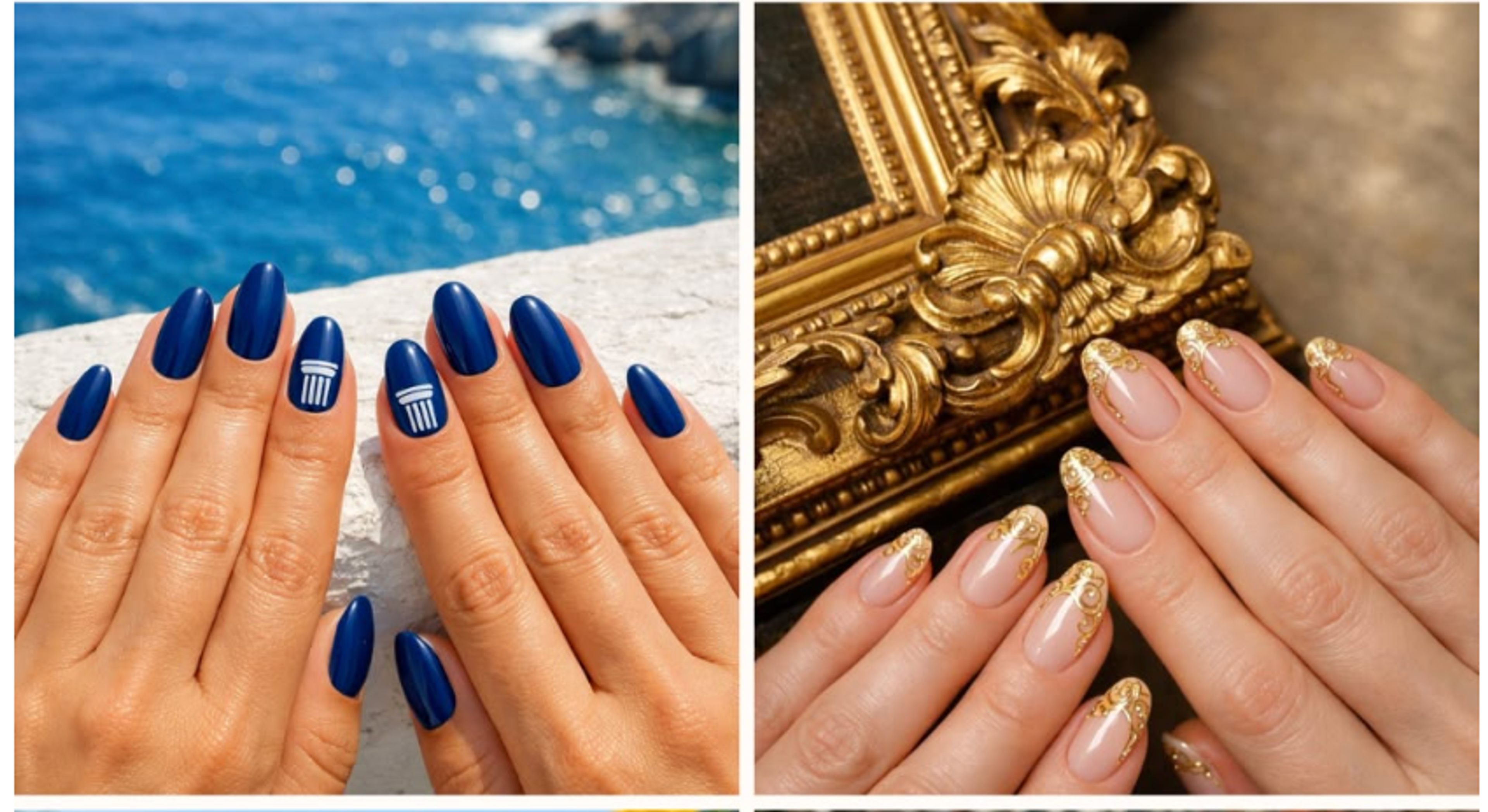
France didn't just give the world the French manicure — it gave the world a philosophy of nails that is still the dominant aesthetic across much of Western Europe: the idea that the most sophisticated thing you can do is look as though you've made no effort at all.
The signature French/Western European nail aesthetic:
- The classic French manicure — sheer pink base, crisp white tip. Invented (or at least popularized) in the 1970s by Jeff Pink for Hollywood, then adopted by France as a permanent fashion staple. Still among the most-requested nail service globally.
- Nude and blush tones — skin-matching shades that enhance rather than announce
- Short to medium length — practical, professional, and never ostentatious
- Soft pastels and muted tones — dusty rose, sage green, warm sand, pale lavender
- Minimal or no art — a single tone, perfectly applied, is considered more sophisticated than elaborate decoration
- 2026 French evolution — the classic French has evolved into "micro French" (ultra-thin, barely visible tips), "glazed French" (milky translucent tip), and "reverse French" (art at the base rather than the tip)
Why French/European nails look like this: The French beauty ideal — je ne sais quoi, effortless chicness, natural beauty enhanced rather than obscured — is deeply culturally embedded. Ostentation is considered mauvais goût (bad taste) in French fashion culture. Nails follow this logic: the best manicure is one you barely notice, yet that leaves an impression of meticulous grooming. Northern European (Scandinavian) culture takes this even further, applying the minimalist design philosophy that characterizes their architecture and interiors to personal beauty as well.
🇬🇧 United Kingdom & London — Fashion-Forward and Gloriously Eccentric
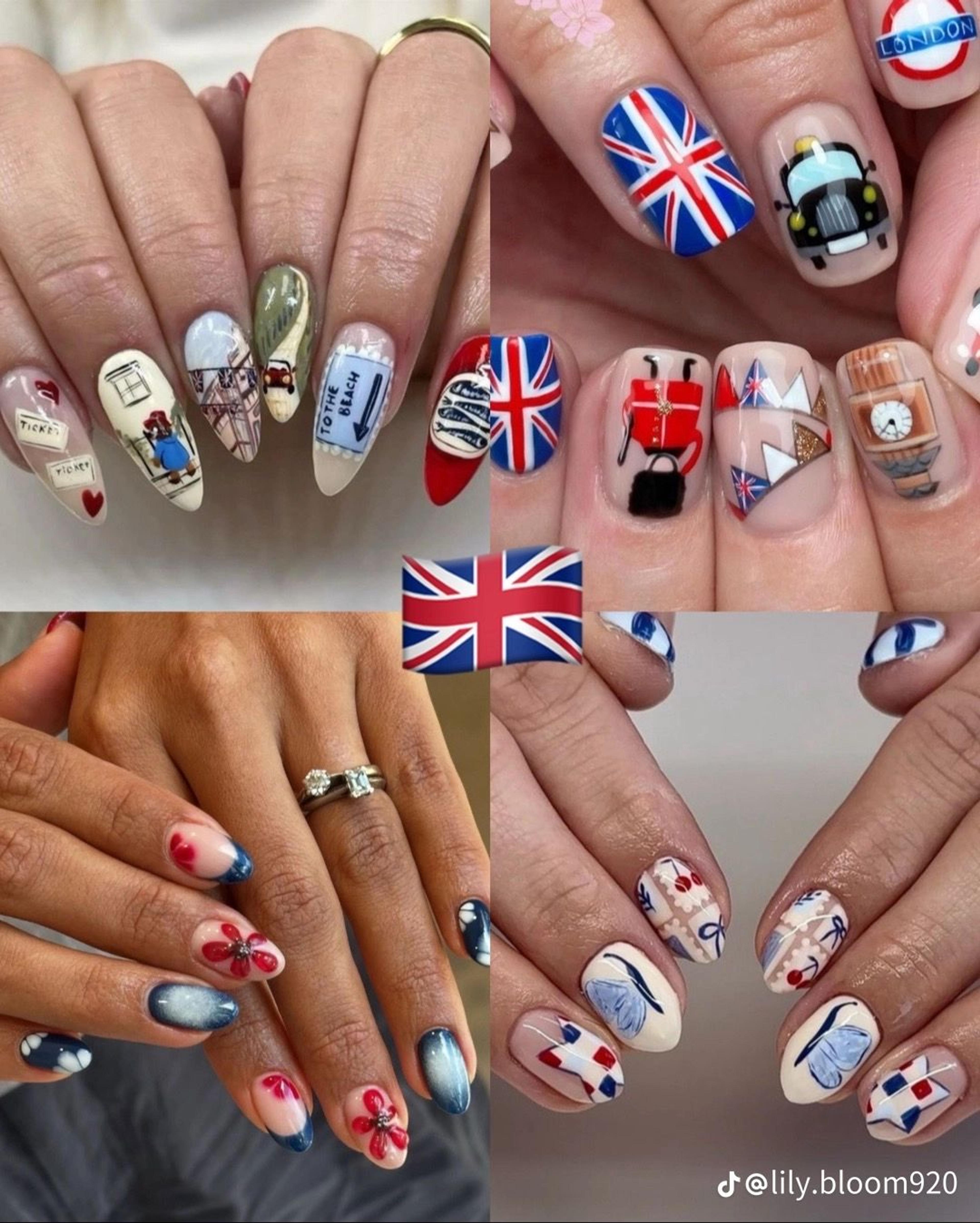
The signature UK nail aesthetic: The UK, particularly London, sits at an interesting crossroads: it inherits French elegance but mixes it with a distinctly British willingness to be weird, fashion-forward, and subversive. London nail culture draws heavily from the fashion industry, street style, and the country's long tradition of punk and DIY creativity.
- Fashion-led art nails — editorial, runway-inspired designs that treat nails as a fashion accessory rather than a beauty routine
- Negative space and geometric art — clean, graphic, modern
- Textured finishes — velvet, leather-effect, and embossed nails
- Nail jewelry — actual jewelry-inspired designs, including chains, pierced nails, and metal elements
- Maximalist vintage — florals, toile prints, plaid patterns (currently trending strongly in 2026), and art-historical references
London's nail artists are consistently among the most experimental and fashion-referenced in the world — they collaborate with designers, appear at London Fashion Week, and push the boundaries of what a nail can be.
🇷🇺 Russia & Eastern Europe — Dramatic, Technical, and Unapologetically Glamorous
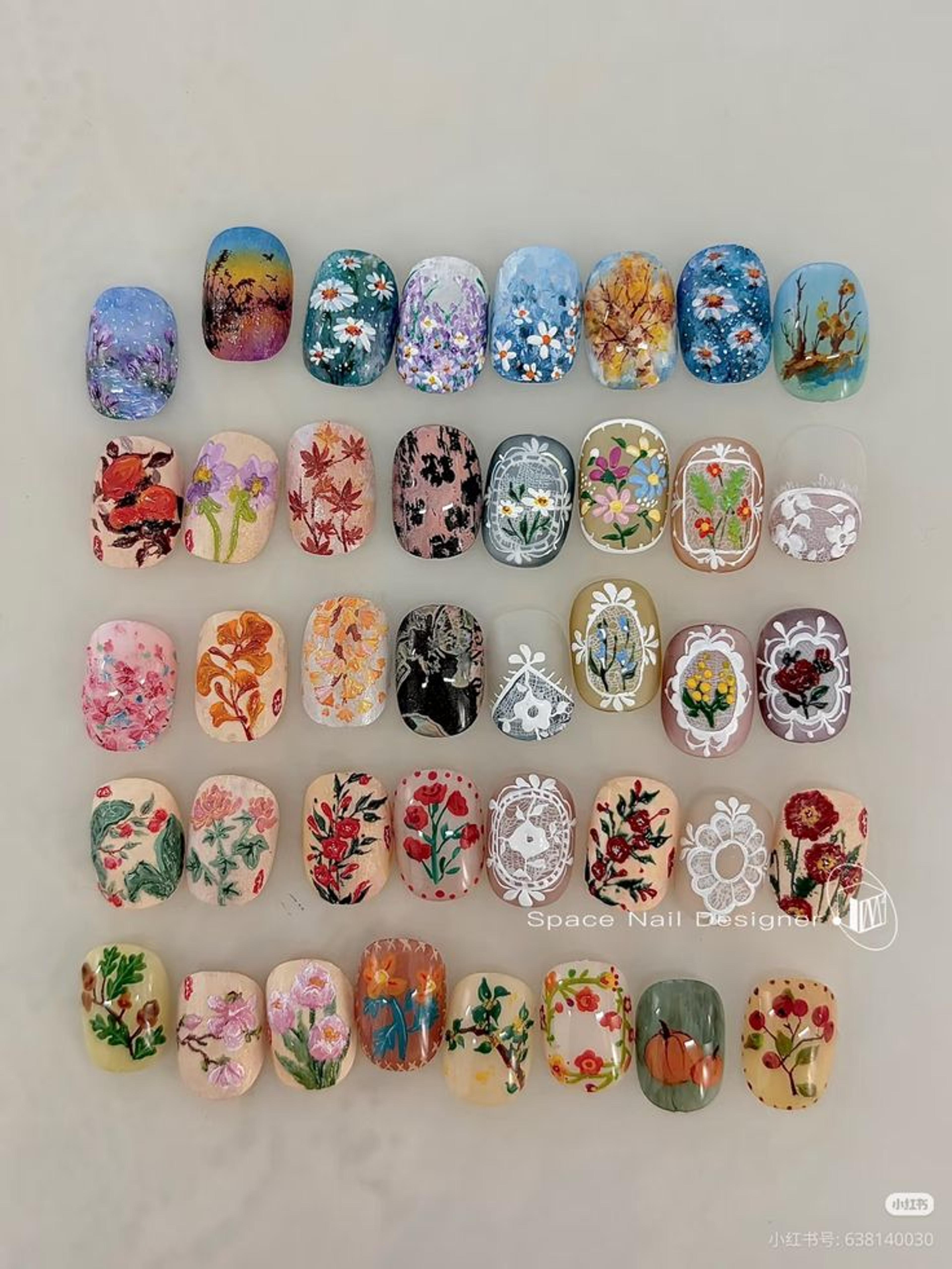
Russia and Eastern Europe have quietly become one of the most technically advanced nail markets in the world — and their aesthetic is unmistakable: maximum length, maximum drama, maximum perfection.
The signature Russian/Eastern European nail aesthetic:
- Long, dramatic extensions — stiletto, extreme coffin, and extra-long almond shapes are standard, not exceptional
- Ombre mastery — Eastern European nail artists are globally renowned for their flawless, seamless gradient work. The "Russian ombre" (also called "baby boomer" or "Russian nude ombre") — a barely-there flesh-to-white gradient — is one of the most technically demanding and widely referenced techniques in professional nail education.
- Chrome and metallic perfection — mirror chrome, holographic chrome, and rose gold are dominant
- Heavy rhinestone and crystal work — not scattered, but architecturally placed. Structured, symmetrical, intentional embellishment.
- Extreme technical precision — Russian nail education is among the most rigorous in the world. The "Russian manicure" (e-file cuticle preparation) is a technique that has spread globally.
Why Russian/Eastern European nails look like this: Glamour in Eastern European beauty culture is aspirational and unapologetic. Unlike Western European minimalism (which equates simplicity with sophistication), Eastern European beauty culture celebrates visible, polished, maximalist glamour as a form of achievement and femininity. The nail salon is a cultural institution — a space of transformation and investment in appearance that is deeply socially validated. Combined with a technical education culture that treats nail technology as a serious professional discipline, the result is some of the most technically sophisticated nail work in the world.
🇨🇳 China — Tradition Meets Digital Maximalism
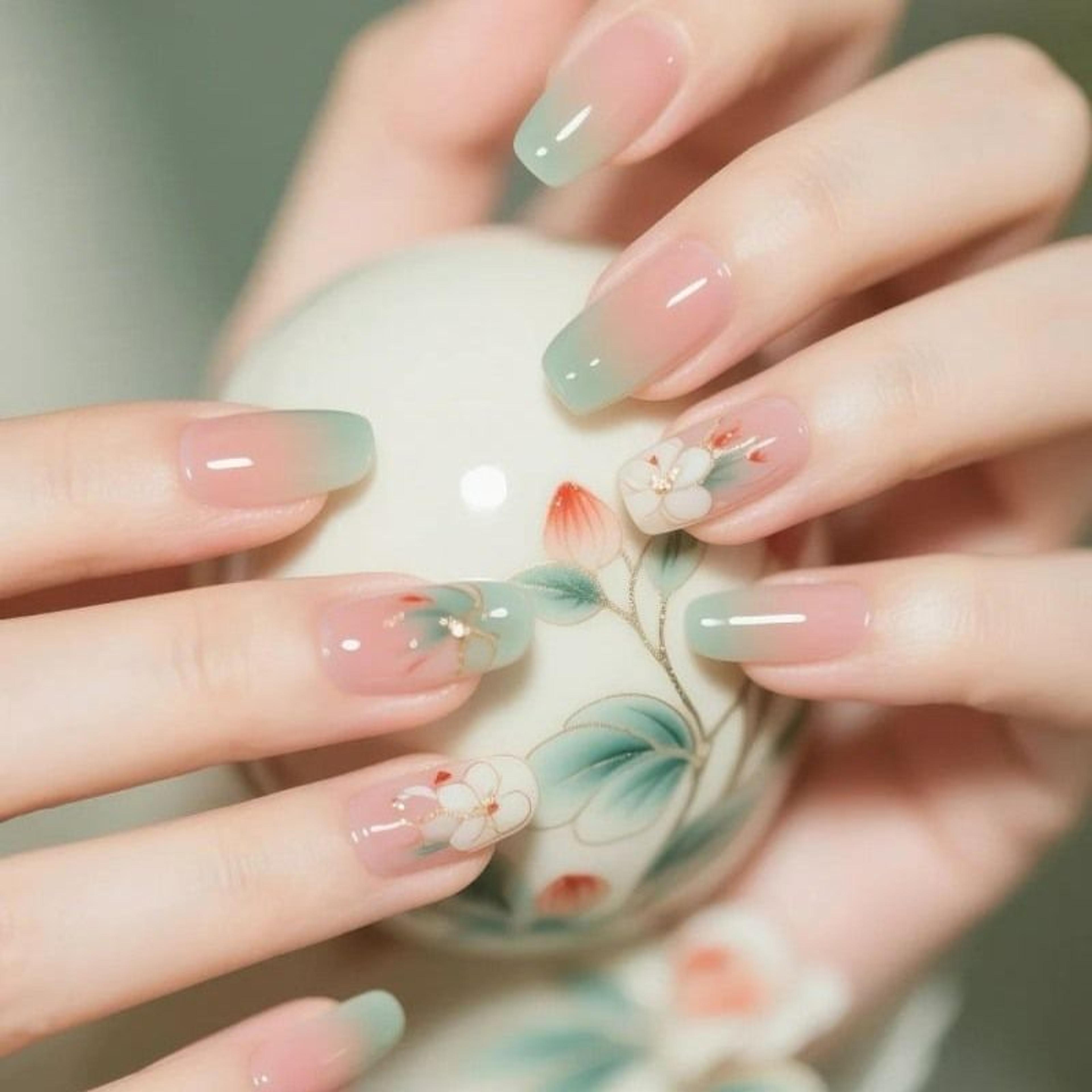
The signature Chinese nail aesthetic: China's nail culture is experiencing rapid evolution — shaped simultaneously by deep traditional aesthetics and by the world's most active social media culture (WeChat, Xiaohongshu/Little Red Book, Douyin/TikTok China).
- Traditional symbolism — red and gold for luck and prosperity, dragon and phoenix motifs, peony flowers, jade-inspired greens. These traditional elements appear in both subtly modern and explicitly ornate forms.
- Feng Shui-informed color — red nails during Lunar New Year, jade greens for wealth, gold for prosperity. Color is rarely arbitrary in traditional Chinese nail aesthetics.
- Ultra-decorated festival nails — during Lunar New Year, weddings, and major festivals, Chinese nail art becomes significantly more elaborate
- Digital-era maximalism — younger Chinese consumers (driven by Xiaohongshu trends) are as trend-literate as any market globally, rapidly adopting Korean glass nails, 3D art, and European minimalism while remixing them with Chinese aesthetic elements
🇧🇷 Brazil & Latin America — Vibrant, Fearless, and Joyfully Expressive
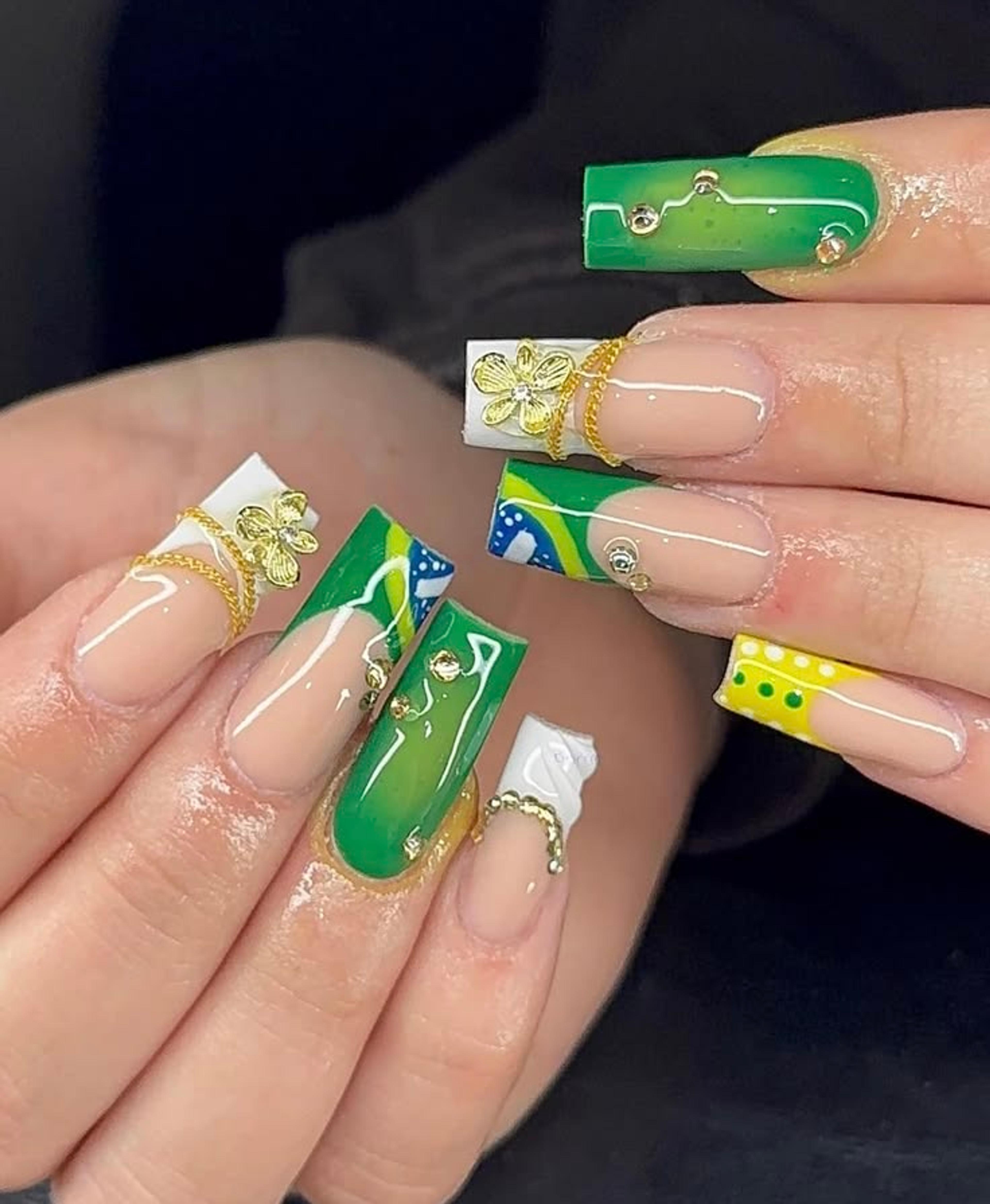
If Korean nails are a whisper, Brazilian nails are a song — and a loud, joyful, unapologetic one at that.
Brazil's nail culture is an extension of the country's most famous cultural expression: Carnival. Joy, color, the body as celebration, and self-presentation as a form of communal festivity shape Brazilian beauty culture at its core.
The signature Brazilian nail aesthetic:
- Bold, saturated color — electric blues, tropical corals, deep fuchsias, sunshine yellows. Color in Brazilian nail culture is meant to be seen, not whispered.
- Glitter and sparkle everywhere — chunky holographic glitter, iridescent foils, and metallic accents
- Tropical and nature-inspired motifs — palm leaves, tropical flowers, birds, ocean waves
- Long nail shapes — coffin and stiletto are widely favored; Brazilian nail culture shares the "longer is more" ethos with the US and Eastern Europe
- Pattern and texture play — animal prints, geometric patterns, mixed media art on nails
- Nail art as cultural narrative — Afro-Brazilian cultural elements, indigenous patterns, and Carnival iconography appear in elaborate artistic nail sets
Why Brazilian nails look like this: Brazil's beauty culture is rooted in joy, self-expression, and the celebration of the body. The cultural influence of Carnival — where color, movement, and spectacle are the dominant aesthetic values — infuses daily fashion and beauty culture. Brazil also has one of the most active nail markets in Latin America, with nail salons embedded in daily social life across economic classes.
🕌 Middle East — Luxury, Geometry, and Sacred Opulence
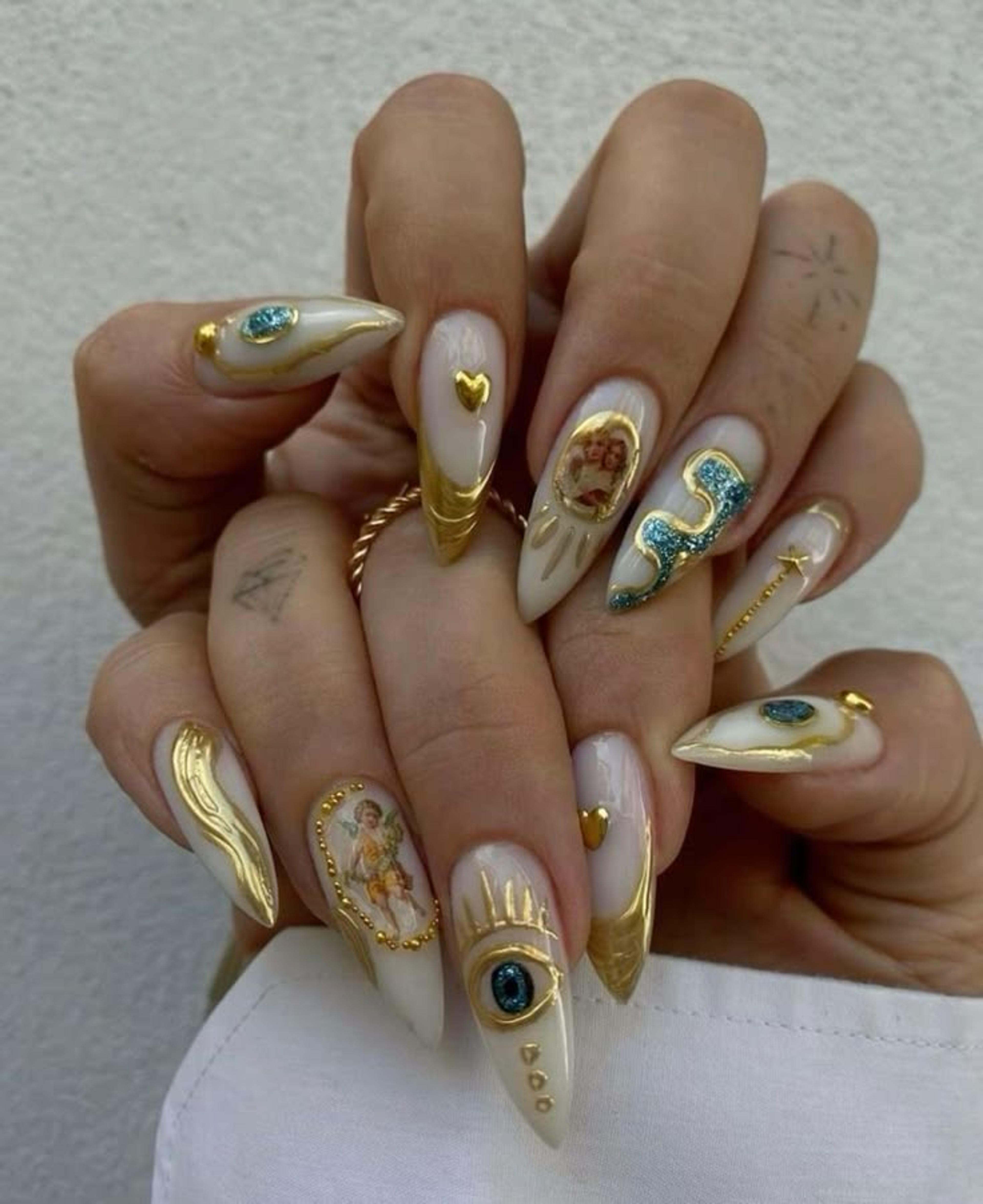
The signature Middle Eastern nail aesthetic: The Middle East — particularly the Gulf countries (UAE, Saudi Arabia, Qatar, Kuwait) — has developed one of the most distinctive and luxurious nail aesthetics in the world. It is an aesthetic that visually communicates wealth, refinement, and cultural heritage simultaneously.
- Gold and metallic dominance — gold chrome, gold foil, and gold-toned embellishment are the signature elements. Gold is not just decorative — it carries deep cultural associations with prosperity and status.
- Geometric Islamic art — arabesque patterns, geometric lattices, and calligraphic elements translated into nail art. These designs draw directly from the magnificent tradition of Islamic geometric art found in mosque tiles, architecture, and textiles.
- Crystal flooding and jewel effects — Swarovski and premium crystal embellishments are used extensively; the visual language of precious jewelry is translated directly to nails
- Long, elegant shapes — long almond and long stiletto are favored for their elegant, elongated lines
- Metallic gradients and aurora effects — iridescent, shifting-color chrome that evokes precious gemstones
Why Middle Eastern nails look like this: In Gulf cultures, beauty presentation is tied to social status and cultural pride. Nails that communicate refinement and expenditure are socially valued. Additionally, in cultural contexts where full fashion expression may be partially constrained by dress codes (in public), nails, jewelry, and personal adornment become important spaces for self-expression — sometimes the most visible form of personal style available.
🇮🇳 India — Henna Traditions, Spiritual Meaning, and Festival Grandeur
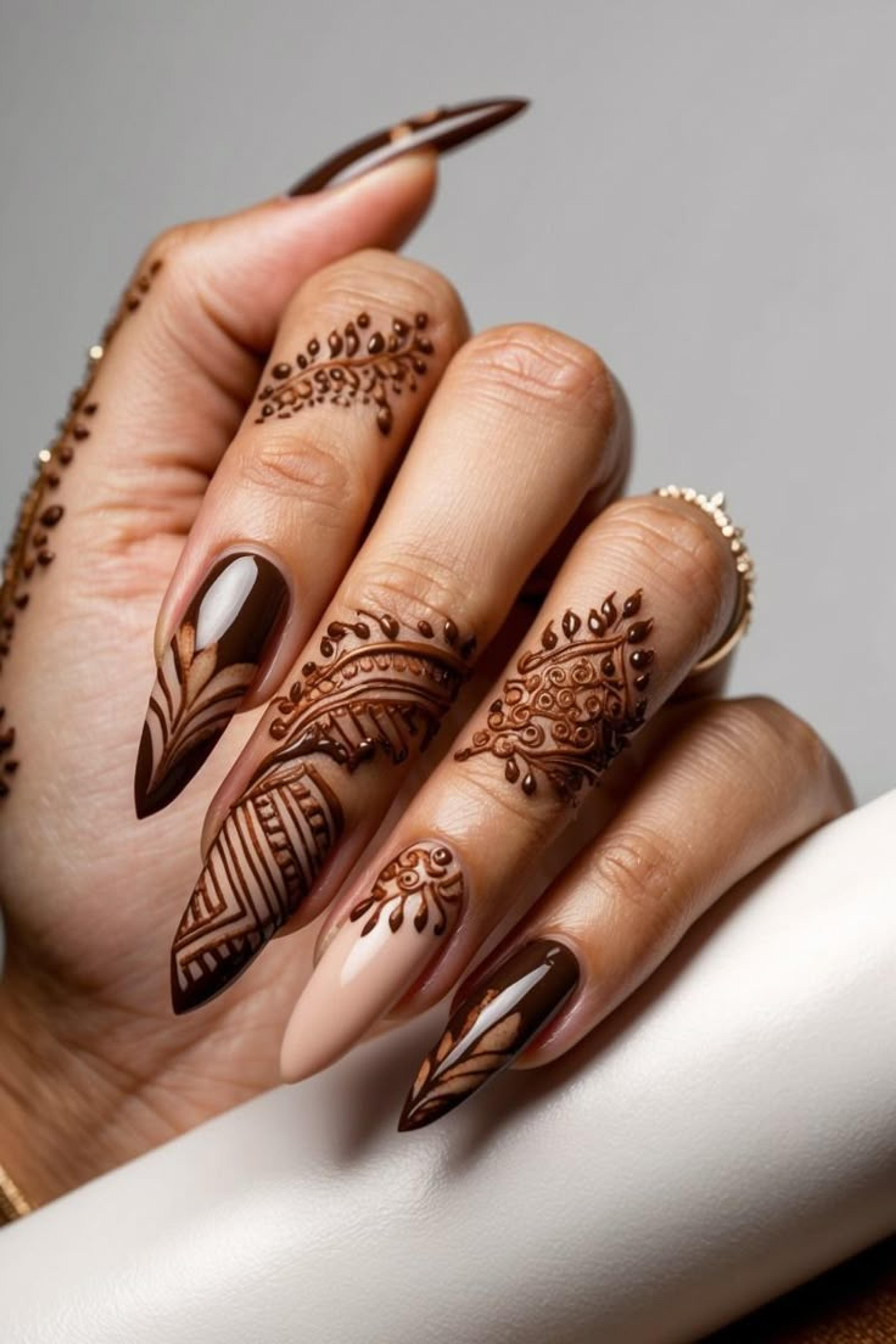
The signature Indian nail aesthetic: India's nail culture is one of the most complex in the world — because India itself is one of the most culturally diverse nations on earth. What unites it is a shared relationship between beauty, spirituality, and celebration.
- Henna-inspired designs — mandala patterns, paisley motifs, and mehndi-style geometric art translated into gel nail painting. These designs carry deep cultural and spiritual resonance.
- Jewel-tone color palette — deep ruby, sapphire, emerald, and marigold yellow are iconic. Indian color culture is among the most sophisticated and symbolically loaded in the world.
- Festival and wedding nails — Indian nail art reaches peak elaborateness during weddings (particularly bridal nail sets), Diwali, and regional festivals. Intricate gold detailing, embedded gems, and traditional motifs are standard for celebration contexts.
- Spiritual symbolism — lotus flowers, peacock feathers, the Om symbol, and other spiritual motifs appear in both traditional and contemporary Indian nail art.
- Contemporary fusion — urban Indian nail culture increasingly blends traditional motifs with global trends: Korean minimalism, Western ombre, and 3D art combined with Indian pattern language
🌴 Southeast Asia — Tropical, Festive, and Quietly Sophisticated
Southeast Asia encompasses enormous diversity — Thailand, Vietnam, Indonesia, the Philippines, Singapore, Malaysia — but certain regional tendencies unite the aesthetic.
The signature Southeast Asian nail aesthetic:
- Tropical color sensibility — coral pinks, aqua blues, mango oranges, and leafy greens that mirror the natural environment
- Festival and ceremony nails — elaborate designs for weddings, Songkran (Thailand), Tet (Vietnam), and other regional celebrations. Festival contexts unlock maximum elaborateness.
- Traditional motifs in modern forms — Thai temple patterns, Indonesian batik geometrics, and Filipino floral motifs interpreted in contemporary gel
- Korean influence — K-beauty's influence in Southeast Asia is enormous. Glass nails, milk nails, and Korean ombre techniques are widely popular throughout the region.
- Vietnamese nail culture specifically — Vietnam has developed a globally notable nail industry. Vietnamese-American nail salons have shaped US nail culture significantly, and Vietnam itself has a rapidly growing domestic nail art culture strongly influenced by both Korean and Japanese aesthetics.
The Global Conversation: How Regions Influence Each Other
Show Image
In 2026, nail aesthetics are more globally interconnected than ever before — and yet more distinctly regional than ever before.
This apparent paradox is explained by the nature of social media influence: TikTok and Instagram expose everyone to every trend simultaneously, which creates a layer of global shared vocabulary (chrome nails, 3D florals, and glass nails are universally recognized). But the interpretation of those trends — how they're adapted, combined, and filtered through local cultural values — is where regional identity reasserts itself.
A Korean nail artist adopts the 3D floral trend but scales it down, keeps it soft, and places a single small bloom on a sheer base. An American nail artist takes the same trend and builds a full garden of rhinestone-centered flowers across all ten nails. A French artist does one accent nail with a minimalist stamped botanical, nine nails bare. Same trend, three completely different cultural expressions.
The major global influence flows of 2026:
- Korea → World: Glass/jelly textures, builder gel culture, chrome techniques, and the "skin-first, art-second" philosophy
- Japan → World: Nuance nails, seasonal themes, 3D gel sculpting techniques
- Russia/Eastern Europe → World: Russian ombre, Russian manicure e-file techniques, precision extension work
- USA → World: Bold length, coffin and stiletto shapes, holiday nail culture, celebrity trend-setting
- France → World: The French manicure (still the world's most requested nail style), nude-first philosophy
What This Means for Nail Artists and Sellers
Understanding global nail aesthetics isn't just culturally interesting — it has direct practical value for nail artists and handmade press-on nail businesses.
For nail artists building a clientele: Knowing where your clients' aesthetic roots lie helps you communicate in their visual language. A client who grew up with Korean beauty influences may be frustrated with heavily embellished sets she perceives as excessive. A client from an Eastern European background may find a "minimalist" design underwhelming.
For Etsy press-on nail sellers: The global nature of Etsy means your buyers may come from anywhere. Understanding which aesthetics resonate with which audiences helps you photograph, describe, and market your sets effectively. Korean-influenced designs (glass, milk nails, soft ombre) perform particularly well with buyers in Asia and Asian-American communities. Maximalist rhinestone sets perform best with US and Latin American buyers. Elegant minimal sets speak to European buyers.
For content creators: The most viral nail content on TikTok and Instagram tends to cross cultural boundaries — it shows something familiar enough to be understandable, but distinctly different enough to feel fresh. Korean nail artists going viral in the US. American nail artists inspiring Japanese artists to experiment with more drama. This cross-cultural currency is one of the most exciting things about being a nail artist on social media in 2026.
Frequently Asked Questions
Which country has the most creative nail art culture?
Japan and the United States consistently produce the most globally influential and technically diverse nail art. Japan leads in craft sophistication and seasonal artistry; the US leads in scale, diversity, and cultural influence. Korea leads in trend-setting, with K-beauty nail aesthetics shaping global preferences more than any other single market.
Why are Korean nails usually shorter than American nails?
Korean beauty culture prioritizes a practical, natural-looking aesthetic rooted in skin-care philosophy. Short, well-maintained nails fit the "clean and healthy" K-beauty ideal. In contrast, US nail culture values dramatic self-expression, and longer lengths are culturally normalized as a beauty statement. Professional and social norms also differ: Korea's conservative professional culture makes short nails more practical for daily life.
Is the French manicure actually French?
Technically, no — the "French manicure" was created by American Jeff Pink of Orly in the 1970s for Hollywood film productions (so that nails could look natural against any costume). It was then popularized in France and became associated with French elegance. The name stuck, and France adopted it so thoroughly that it genuinely became a cornerstone of French beauty culture.
Which nail aesthetic is growing fastest globally in 2026?
Korean nail aesthetics — particularly glass nails, milk nails, and clean minimal chrome — are growing fastest in global adoption, driven by K-pop, K-drama, and K-beauty's enormous international cultural influence. The "K-nail" aesthetic is now as globally recognized as K-skincare.
Can nail aesthetics genuinely change across cultures, or is social media flattening global trends?
Both are true simultaneously. Social media creates shared trend vocabulary — chrome nails and 3D florals are globally recognized in 2026. But cultural interpretation persists. A nail trend that arrives globally is absorbed through a regional filter — adapted to local color preferences, length norms, and aesthetic values. The result is a rich global conversation where the same visual idea produces radically different cultural expressions.
Final Thoughts
Nails are fingertip diaries. They tell you where someone is from, what they value, who inspires them, and how they want to be seen in the world.
The soft glass nail from Seoul whispers: I am polished, effortless, and quietly self-assured. The rhinestone-flooded stiletto from New York shouts: I am here, I am bold, and I have arrived. The henna-motif mandala nail from Mumbai says: I carry beauty traditions from a thousand years of culture on my fingertips.
None of these is more valid than the others. All of them are art. All of them are stories.
And in 2026, with nail design communities connecting across borders in real time, those stories are beginning — beautifully, imperfectly — to talk to each other.
Sources & Further Reading:
- Who What Wear: LA, London, Seoul, Tokyo — 12 International Nail Trends
- Stylist: Everything About Japanese and Korean Nail Art
- Mojii Nail Spa: Nail Art Around the World
- Sweetie Nail Supply: Western vs Korean vs Japanese Gels
- Bustle: K-Beauty Nail Trends 2026
- Vogue Scandinavia: 7 Non-Negotiable Nail Trends 2026
- Emmi Nail: Nail Art Designs from Different Cultures
- WJARR: Nail Design as Self-Expression — American and European Approaches


